Thursday, 28 September 2017

Ruff time at WOW

WOW has been very good for ruff recently. Not only have there been up to ten present but they have been imitating the godwits and coming right up to the window and giving stunningly close views. Sometimes they are so close I cannot get the digiscoping equipment working as they fill the frame. There are over 100 teal and last week we had the first adult shelduck back in. There was also a kingfisher present, seen twice and perched on the post in front of the window just long enough to miss a photo opportunity - as I reached for the button it flew off. The terns are gone as are the swallows and martins but there were 60+ lapwings, 5 redshank and four grey herons.

The coastal patch remains quiet and has not produced a new bird since May. The tern loafing area only "terned" up sandwich, roseates have been conspicious by their absence and I have dipped on common and arctic as well as shearwater this year. I will struggle to hit 70 this year in North Down and am still 6 short of the 100 target at WOW/Kinnegar.


Belfast Lough

Sandwich tern

Adult and young


No apologies for the mass of ruff shots as it was difficult to leave any out. The first half dozen were taken on September 14th

Ruff and blackwits not digiscoped.

Digiscoped!!

Collective noun for ruff? Apparently it is "a hill"


Redshank at rest

Great black-backed gull
 The gull was eating a carcass and very mobile, again it was difficult to set up the digiscope as it was quite big and quite close. The next selection were snapped on September 21st.

Redshank reflection

A hill of ruffs, possibly juveniles


Juvenile ruff?

Adult male?
Thanks to Google I can now go in to WOW and say, "Look, a hill of ruffs" and be greeted with more scorn than normal. It makes a change to our usual counting method which involves liberal use of Ulster-Scots, as in a wheen of curlew,  a lock of geese or a wild lot o' mallard. "Look there's a quare lock of geese about th'day"

Today (September 28) again had 7 ruff and 25 species in all - low tide and no feeders. The bonus was a superb peregrine which appeared on two occasions, but better than that were three WOW ticks in the form of grey wagtail, stonechat and water rail, which was also a 2017 tick. It appeared briefly three times in the cut reed channel before I got the kit set up. The camera remained focused there for three hours but it never appeared again. There were lots of moorhens so here is one I took as practice in case the water rail re-appeared. It was an argy-bargy with a young moorhen which put me on to it. It then had the decency to re-appear briefly twice so everyone got a look at it.

Nice moorhen waiting for the water rail to appear


2017

206: Water rail
 
Bangor West
66: Raven 

Belfast WOW
95: Water rail
96: Stonechat
97: Grey wagtail


Saturday, 9 September 2017

Patches grind to a halt

Not a lot to report. I have had three walks in the evening to try and add manx shearwater to the list and have failed each time. WOW has turned up some nice birds but not on a Thursday morning. Water levels remain high and waders are hard to attract. The best on Thursday was over 200 house martin in and around the reserve, a sparrowhawk thermalling and two swift - late birds indeed as I have never seen swift in Northern Ireland in September. There was also a 100+ finch flock in the distance - too far away to be sure of what was in it. The total for the morning was 27 which was 3 more than I got in Italy and San Marino over 6 days!! The beauty of expecting no birds at all in Italy was the excitement of seeing even one. By the end of the holiday I had added 5 birds to the 2017 list including a Bolton tawny owl and a life first in great white egret on Terciello. I also spotted Italian sparrow in Venice, a black kite over the A14 and gull billed tern in Venice lagoon. San Marino came up with two totally unexpected jays. Venice was awash with yellow-legged gulls and Cesenatico managed a redstart in the park and a black-necked grebe swimming around the water feature which runs through the town!! Little egrets were quite common in Venice lagoon and in the park at Cesenatico but they are not the exciting bird they were 30 years ago seeing as I have seen one in the Rathmore Estate in Bangor!! Any additions to lists will now involve a lot of graft and a slice of luck even though there are three months to go - the joys of patch birding.

BNG with the phone, wasn't expecting a megatick en route to dinner.

Cesenatico yellow legged gull

Young gull looking for pizza.
 Interesting pic of the young yellow-legged gull is that it has pink legs, maybe I need to look more carefully at first and second year lesser black backs and herring gulls, or maybe life is too short and I will wait for an adult!

2017
201: Tawny owl
202: Italian sparrow
203: Gull billed tern 
204: Great white egret
205: Black kite
 
Bangor West
66: Raven 

Belfast WOW
93: Greenshank


Tuesday, 22 August 2017

Travelling again

A brief update to keep things ticking over before we travel to Bolton, Venice and San Marino. I have surfed birding in  Italy and am not that hopeful of much in the way of birds, so anything is a bonus. Bolton involves a lot of family so opportunities will be limited there as well. Last week saw WOW produce 35 species including common sandpiper, ruff, raven and sparrowhawk. I had a couple of days at Castlerock and finally got a key for the Barmouth hide. An hour on a dropping tide gave good views of greenshank, curlew, knot, blackwit, redshank and dunlin. Nice to link up with Richard Donaghy and put a face to a good website (http://causewaycoastrg.blogspot.co.uk/ ). Things are generally quiet all round and the patch lists show no change,  so a couple of pics and see you in September.


Greenshank

Friday, 11 August 2017

200 up

Finally ticked number 200 for the year a mandarin duck on the River Braid at Broughshane. Number 200 had to be a bit out of the ordinary as I have most of the common stuff. Mind you I missed cuckoo, whimbrel and grey plover, might get the latter two but cuckoo has passed me by. WOW on Thursday was relatively quiet with less than 30 species seen. Highlights were a common sandpiper and a greenshank at Kinnegar. Ten greylag appeared and two of them had neck collars on as part of a study funded by the Airport to see where they go and how this might impact on the planes. Feral greylags continue to be a problem!! Black-tailed godwit numbers reached 250+ as the tide pushed in and one of them appeared to be hopping on one leg. It turned out to have a cockle shell clamped to one of its toes so was unable to put its foot to the ground. It can feed and fly but is a bit slow in the take off department so has a higher chance of falling to a predator.

Godwits feeding right up to the window

Second or third brood of mallards

The cockle shell hero

Serene coots

Tranquility

Moorhen at rest
2017
200: Mandarin
 
Bangor West

66: Raven
  
Belfast WOW
93: Greenshank

Friday, 4 August 2017

Ailsa Craig plus plus

It’s been busy few weeks with a trip to Ailsa Craig and Portmore Lough as well as duties at WOW. Ailsa Craig turned out to be a bit iffy weather wise as it was windy and rainy – heavy squally showers. The birds were up to scratch with the 30000+ gannets, all the auks, fulmar, shag, cormorant, oystercatcher, ringed plover and four species of gull. We also saw common and grey seal and slow worms which are easily found on the island. The journey over gave good views of Manx shearwaters and 3 sandwich terns. The main problem was in getting back off as it was choppy with quite a swell and we had to wait until the boat came in to the pier, then step/jump onto the rubber hull, grab the hand rail hang on and inch back towards the stern.  We could only do two at a time and with quite a few attempts to get into position it took 45 minutes to get all 8 of us back on board. Suffice to say we were all relieved when the operation was complete and we were able to head back to Cushendall. We picked up peregrine on the coast on the way back which was a nice bonus as the nest on Ailsa was empty and we could not find any around the island.

Slow worm

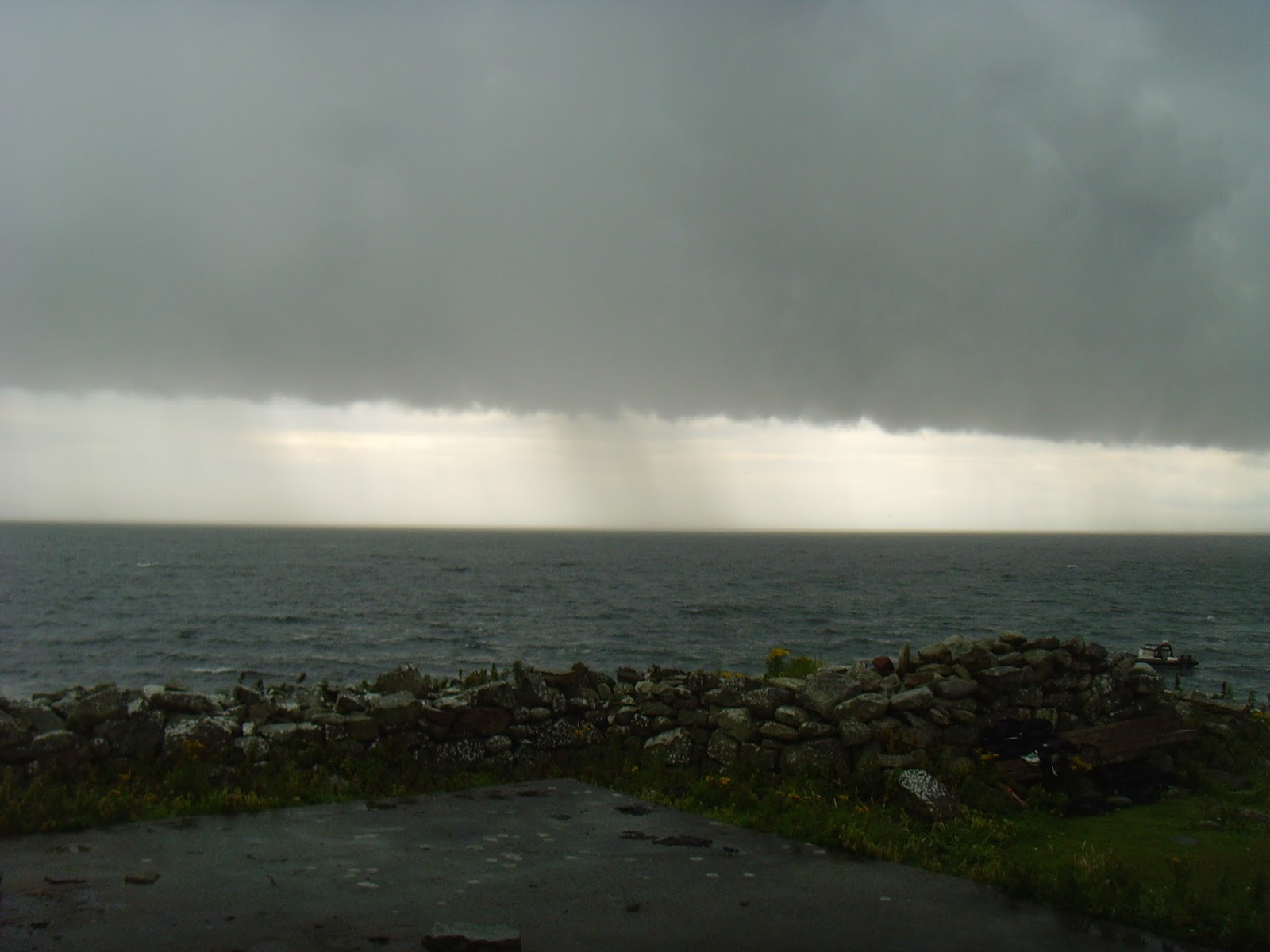
Passing squall

Embarcation!!
 Portmore Lough RSPB reserve hosted a barbecue for volunteers and a guided tour. The highlight was the breeding common terns – 102 nests this year. We also saw little grebe, great crested grebe, tree sparrows and over 100 mute swans as well as coot, tufted, mallard and gadwall.  The wildflower meadow was at its best and there were good numbers of butterflies, mainly green-veined white. It was nice to see another reserve and to catch up on the work there. 

Tern raft

Wild flower meadow
 Visited Rowallane for a walk and picked up breeding swallows, two nests and five young.


Belfast WOW is still fairly quiet as the main wader passage hasn't kicked in yet. Thursday saw common sandpiper, ruff and sanderling as well as 600+ black-tailed godwits, some still in breeding plumage having newly arrived from Iceland. The entire reseve lifted twice, once when a buzzard came in and then when a raven paid a visit. Lesser black-backed gulls also cause a stir if they do not fly high and straight over. There were still sand martins and swifts, plus over 220 black-headed gulls and 250+ common terns including a good number of chicks. Only the gulls and terns came over to be photographed, everything else stayed on the far side. I need to get a nice moorhen or coot shot, but those who come close move about too quickly for the digiscope set up. The two below had the decency to pose for a while.

Common tern

Black-headed gull


2017
199: Black-necked grebe
 
Bangor West
66: Raven
  
Belfast WOW
91: Sanderling
92: Raven

Thursday, 20 July 2017

Belfast WOW

Back at WOW after three weeks to find dropping water levels and even more gull and tern chicks. Again we had over 30 species including common sandpiper and little egret. The Mediterranean gulls have moved off the island and can turn up anywhere on the reserve. At one point we saw three but a passing black back put everything up and we lost them. This happened several times, mainly with lesser black-backs but also with hooded crows and buzzard. The hoodies work in pairs, one comes in and everything lifts up to give chase, meanwhile the second one flies in behind looking for a snack in the now unguarded nests. Fortunately they have not been overly successful as the vegetation is now about two feet high and the chicks are well hidden. The estimate is at least 250 tern nests on the reserve.
Med gull
Common sandpiper

2017
199: Black-necked grebe
 
Bangor West
66: Raven
  
Belfast WOW
89: Little egret

Wednesday, 19 July 2017

A two owl day

 
The grand tour of Scotland and England was mainly a family trip but I managed to squeeze in a couple of half days in the field. The ferry across produced a lot of Manx shearwater, gannet and guillemot. Scotland was as expected but produced some nice views.

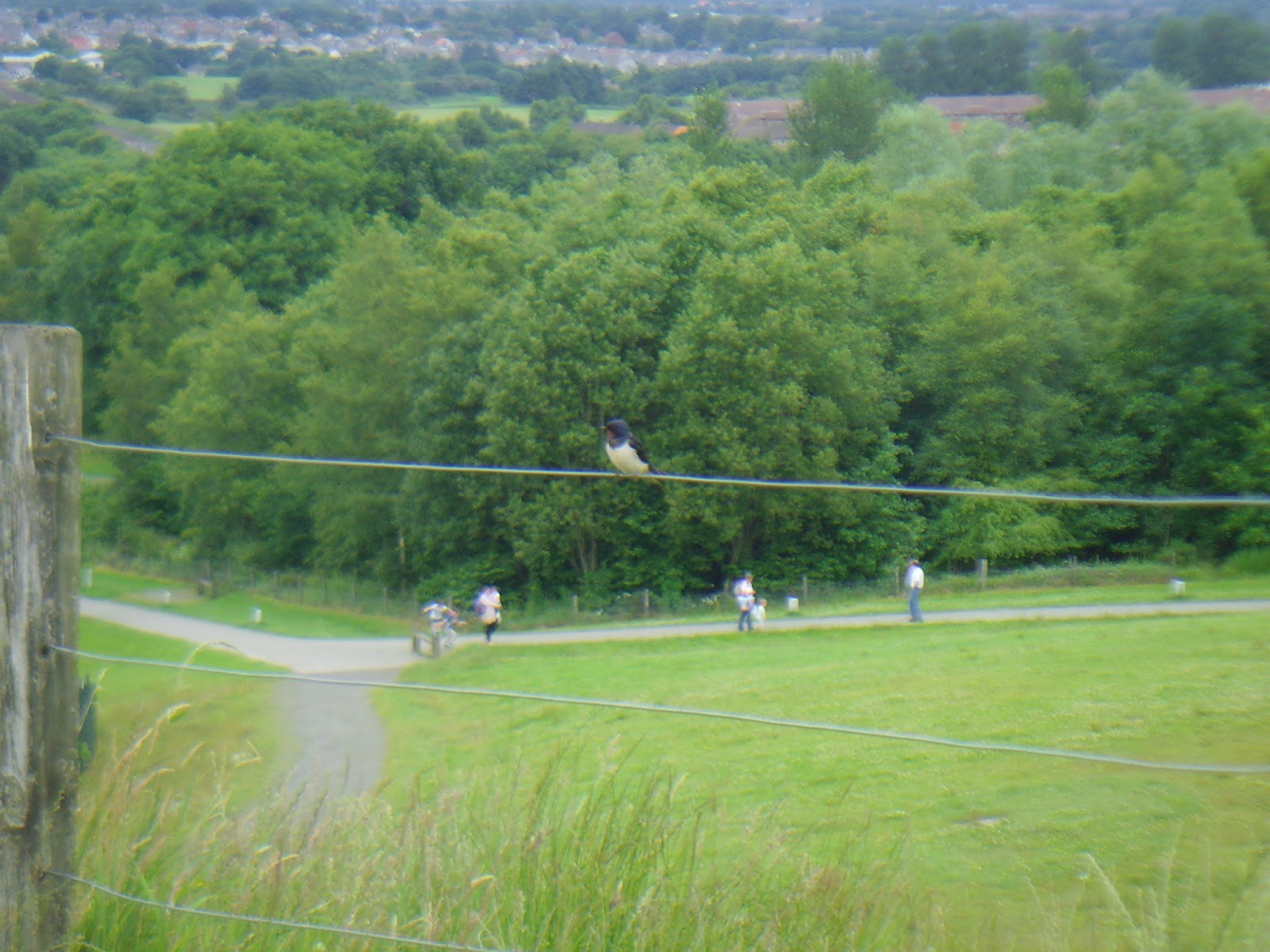
Swallow

Swallow

The Kelpies

Falkirk Wheel
Druridge Bay and Widdrington
On Saturday July 8th I went looking for spoonbills at Widdrington and little owls at Druridge. Anything else was a bonus. Cresswell was too high for waders and I moved on to Druridge Pools and got whooper swan, wood sandpiper, little ringed plover and blackwits. The owl site at Druridge gave three good birds but no owls. There was however a juvenile green woodpecker sitting on a fence where the owl was supposed to be. Then I checked the field behind me and had two red-legged partridge in the wheel tracks of a large barley field.  A check on another owl site produced a bird on the wall which turned out to be a yellow wagtail. The spoonbills were a no show at Cresswell, Druridge and Widdrington, and appeared to have moved on as I also checked these sites the following evening at dusk. I also saw yellowhammer, skylark, whitethroat and sedge warbler in a list of 56 species. It is some time since I have birded this area in summer so it was a nice change to sit in the heat and have long clear nights.
Saturday also saw a quick visit to the all singing all dancing new Hauxley reserve which seems to have become goose central, they really will have to do something about the sheer numbers of greylag and Canada geese. I had a quick look round and was glad to see new feeders close to the centre, but had no time to walk the new circular route.
Sunday saw a quick trip to St Mary’s lighthouse which had a flock of 25 golden plover flying in off the sea. I then decided to try Druridge again at dusk having had advice from Bird Forum as to where I should be looking and BINGO – two little owls showing well as they say. Thanks to the two other birders who were there and helped me along even though I spooked one of the owls as they were trying to photograph it. I said I would go on to Cresswell and try for the barn owl only to be told it was flying around the fields behind me!! BINGO – a two owl day!!
Clearly I need to visit again in the summer as I added 5 birds to my NE list – little owl, wood sandpiper, green woodpecker, red-legged partridge and yellow wagtail. I have a very clear memory of going to Cresswell in 1994 to look for yellow wagtail rather than watch the World Cup final between Italy and Brazil. I didn’t miss any goals as it was a 0 – 0, but I didn’t get the wagtail either. Never mind, 23 years later it’s in the bag and on the list.
Bawtry
The plan was to look for honey buzzard at Clumber Park but they haven’t been seen there recently and appear to be no longer breeding. The park itself is wooded and pleasant but the main area round the house was wall to wall people and huge numbers of Canada and greylag geese. Like Hauxley – they have a problem.  A quick about turn took us to Potteric Carr a Yorkshire Wildlife Trust reserve on the outskirts of Doncaster with breeding bittern. Like so many urban reserves it is an oasis in a sea of concrete and is well worth a visit if you are in the area. You can take as long as you like as there is an exit system operating once the reserve closes – remember to leave your car outside the car park which is locked. We managed a couple of hours in late afternoon and were rewarded with marsh harrier, green sandpiper, avocet, singing chiffchaff and black-necked grebe. 

Bolton
Nothing untoward in Bolton but I had a look at my list when I got home and discovered that in seven years of occasional visits I have not recorded peregrine, curlew, house martin, rook, grey wagtail or meadow pipit!! Some of these are probably omissions others need to be looked for. Either way I need to get out more instead of playing with the grand children – only joking Freddy.
Belfast RSPB and North Down  unsurprisingly report no change.

2017

192: Manx shearwater

193: Yellowhammer

194: Skylark

165: Green woodpecker

196: Red-legged partridge

197: Little owl

198: Barn owl

199: Black-necked grebe

Bangor West
66: Raven
  
Belfast WOW
88: Wood sandpiper