Monday, 5 October 2015

The autumn moon lights my way

Hard to believe the patchwork challenge is three quarters of the way there and for the first time I managed a month with no patch ticks. Partly because I have got most of what I am going to get and secondly because most of the month was spent "Rambling On". I dashed outside last week to look at a flock flying over but lost them so they remain a mystery. I am still missing mute swan, coot and moorhen.

A week in France around Nice and Vence  produced two new year ticks in the shape of a Fischer's lovebird, an escaped species which is common in and around Beaulieu, and a white wagtail. Yellow legged gulls were the default gull and this one came down to a puddle for a drink.


Yellow-legged gull

 Pennington Flash in Manchester produced a lovely nuthatch and the Wetland centre at Barnes Elms gave superb views of a hobby thanks to a bird ringiing team who put me on to it. I only caught the tail end of the ringing but it was fascinating to watch and an education for me as a birder. I have been birding almost 40 years and this was the first time I have been up close and personal with the objects of my hobby. The other feature of this site was the total lack of large aircraft heading for Heathrow which gave it a beautiful noise free quality. The blocking high meant that the flight path did not go over the reserve and we had blissful silence instead of a 747 every two minutes.


Belfast WOW last week had 32 species including 104 teal, 6 common tern, 2 coal tit and a late house martin.

London wetland


Chiffchaff

Long-tailed tit

Ruff from WOW a couple of weeks back.

Tuesday, 1 September 2015

Garden tick for raven

You read it here first. While painting the gate to the rear garden this morning I heard a familiar "Kronk, kronk" overhead and there was a raven flying over the garden towards central Bangor. I have been anticipating this for some time but it is still nice to see and hear it. Next year Castle Park is off the patch and Ballyholme is on.

I spent a pleasant 90 minutes sitting at Stricklands Bay behind the scope on Sunday afternoon. The thinking was that the terns sit on the point to the west and I might get some shots. The best ones are these two of common terns - a patch tick no less.


There were also sandwich and arctic terns, gannet, guillemot, cormorant, shag, oystercatcher, turnstone, redshank, herring gull, black-headed gull and various passerines such as swallow, house martin, magpie, wood pigeon, pied wagtail and blackbird. 

Belfast WOW has better water levels and August 20th was a good morning all round producing 38 ruff, little stint, wood sandpiper, common sandpiper, greenshank, sanderling, spotted redshank and an immature peregrine hunting unsucessfully. Most of the terns have fledged and numbers are down to a couple of hundred, but we had 35 species all told as we had 6 people working scopes at the same time, hence the extensive list. If something appeared somebody was on to it. There was also a 60+ finch flock at the back of the reserve, mainly goldfinch and linnet and a passing buzzard. In previous years I have gone there to see a ruff and been over the moon to see two, nearly 40 was incredible. Later in the week there were more than 50. The waders are on the move and autumn is on the way.

The following day we had a quick visit to the Quoile and managed to see over 100 mute swans and a kingfisher, first there for a long time. Most stuff was on the far side and I did not have a scope as I was not expecting to be there. 


Patch list 67 - common tern

Monday, 10 August 2015

Golden eagle

We had a trip up the North Coast last week and had a couple of outings to Rathlin and Malin Head as well as a look at the Barmouth hide.

Barmouth hide
An hour here produced all the usual estuary/mudflat birds and a juvenile peregrine which landed briefly on one of the seaweed covered rocks. The trip to Malin also turned up a juvenile peregrine but not the hoped for chough. Basically there were too many people about. I did pick up fulmar and gannet offshore but other than that everything was as expected.
Malin Head

Chough free zone

The Rathlin trip was to attempt the Kinramer North walk which is the most difficult of the five off road walks,   " For the intrepid walker",  according to the leaflet. It cuts North at the Kebble to the North cliffs, along the cliffs and then back to the road. Like all walks on Rathlin the scenery is spectacular and the bird list always turns up the unexpected, in this case 4 great skua using a lake  to bathe in and then an immature golden eagle between us and the West lighthouse.  The minute I got the binoculars on the bird I said to my two companions, "That is a golden eagle". Then I thought to myself, don't be daft it is probably a buzzard, but the longer I looked the more sure I was - white patches above and below on the wings and the sheer size of the bird. It flapped and soared over a valley between us and the seabird colonies but would have been impossible to see from there. It was in sight from the road but there were no birders, only tourists to see the puffins! It eventually dropped in to the dip and out of sight and despite being in the area for around two hours we did not see it again. Never mind, a first for Northern Ireland, all Ireland and Co Antrim. I have been looking for an eagle here for a long time and when I finally got one it was on our 44th wedding anniversary, how good is that? The total for the trip was 33, well down on Rathlin standards but we also saw buzzard, kestrel, stonechat, skylark, reed bunting and about 15 manx shearwaters from the ferry. All in all a good day. We finished off at Harry's Shack for a meal - good food but slow service - the eagle was the more memorable experience of the two.

North cliffs looking East

Stunning view

Looking West, this is where the eagle appeared about five minutes later.

Sunday, 2 August 2015

Coquet Island

Following the boat trip theme I was able to do a trip round Coquet Island, a small RSPB reserve off the Northumberland coast. Landing is not allowed on the island so we were confined to floating around just offshore. There is a breeding colony of almost 40,000 puffins as well as arctic, sandwich, common and roseate terns. The 100 pairs of roseate terns are the largest colony in the UK. We managed to see all of these plus fulmar and kittiwake. The boat trip from Amble also gave good views of eider, cormorant, 4 gull species and merganser. 

Coquet Island lighthouse

Dripping with puffins

Tern and puffin


For the rest of the day we explored the coast  and saw 50 species in all including barwit, blackwit, little egret, avocet, stonechat, linnet and tree sparrow. 

Cresswell Pond, there is an avocet here!!

 I returned to Belfast WOW on Thursday last hoping to see the white-rumped sandpiper which had been present for three days when I was in England, unfortunately despite the best efforts of eight quality birders it could not be located, the bird had flown. Nevertheless we managed 31 species including 2 common sandpiper, snipe, ruff and around 130 dunlin all of which were eagerly scanned several times over. It is probably not a good idea to look at NIBirds when you are in England as it can be a little frustrating. The last time this happened I was in Northumberland while a snowy owl was up around Binevenagh.

Patch watching remains static as I have found most of the birds I expect to see. The latest addition was a buzzard which was soaring somewhere over Bangor West before heading back towards Crawfordsburn. I am on 66 species and would like to think I will make 70. Anything over and above that will be a bonus.

Wednesday, 15 July 2015

Ailsa Craig boat trip

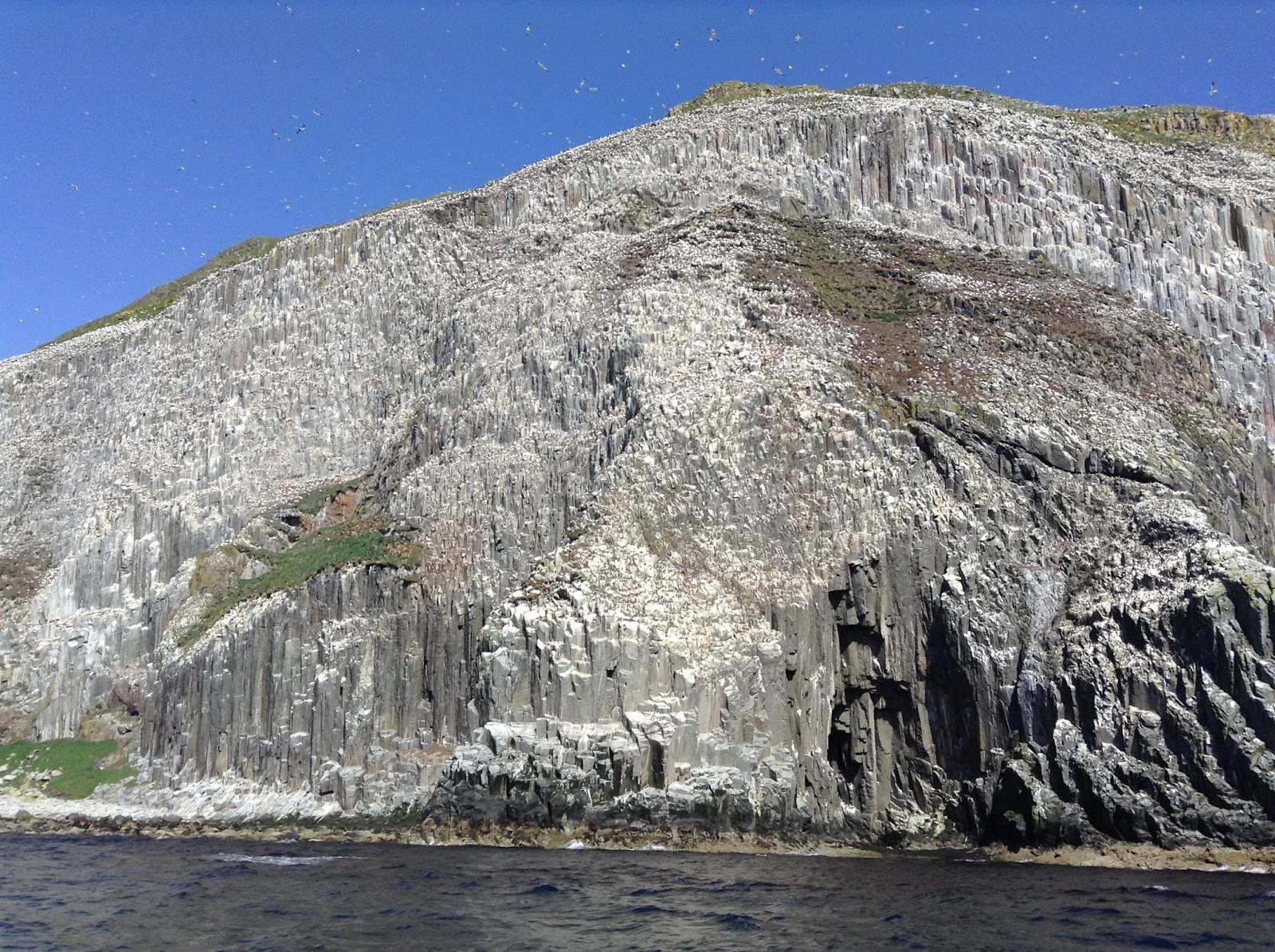
Having missed out on the Rathlin trip due to bad weather I was fortunate enough to be able to go on a trip to Ailsa Craig on Tuesday. This left Cushendall around 1000 and reached Ailsa Craig about two hours later. The sight, sound and smell is fantastic - one of nature's wonders.

Gannetry
 We viewed the gannet colony (36000 breeding pairs) and the auks (10000 breeding pairs).  At one stage the boat was surronded by guillemots and the two nearest to the boat were bridled guillemots, a first for me and many of the other passengers.

Bridled guillemot is extreme left
 We had an hour on shore,  just time enough to lunch and explore a small area round the landing stage.


 There is a small rail network which was used to bring granite from the quarry to the pier so as it could be shipped to the mainland. Ailsa granite is used to make curling stones as it is the best type of granite to use. Apparently all the curling stones in the world are made from Ailsa granite. They were allowed to quarry 2,000 tons in 2013 sufficient to fill anticipated orders until at least 2020.

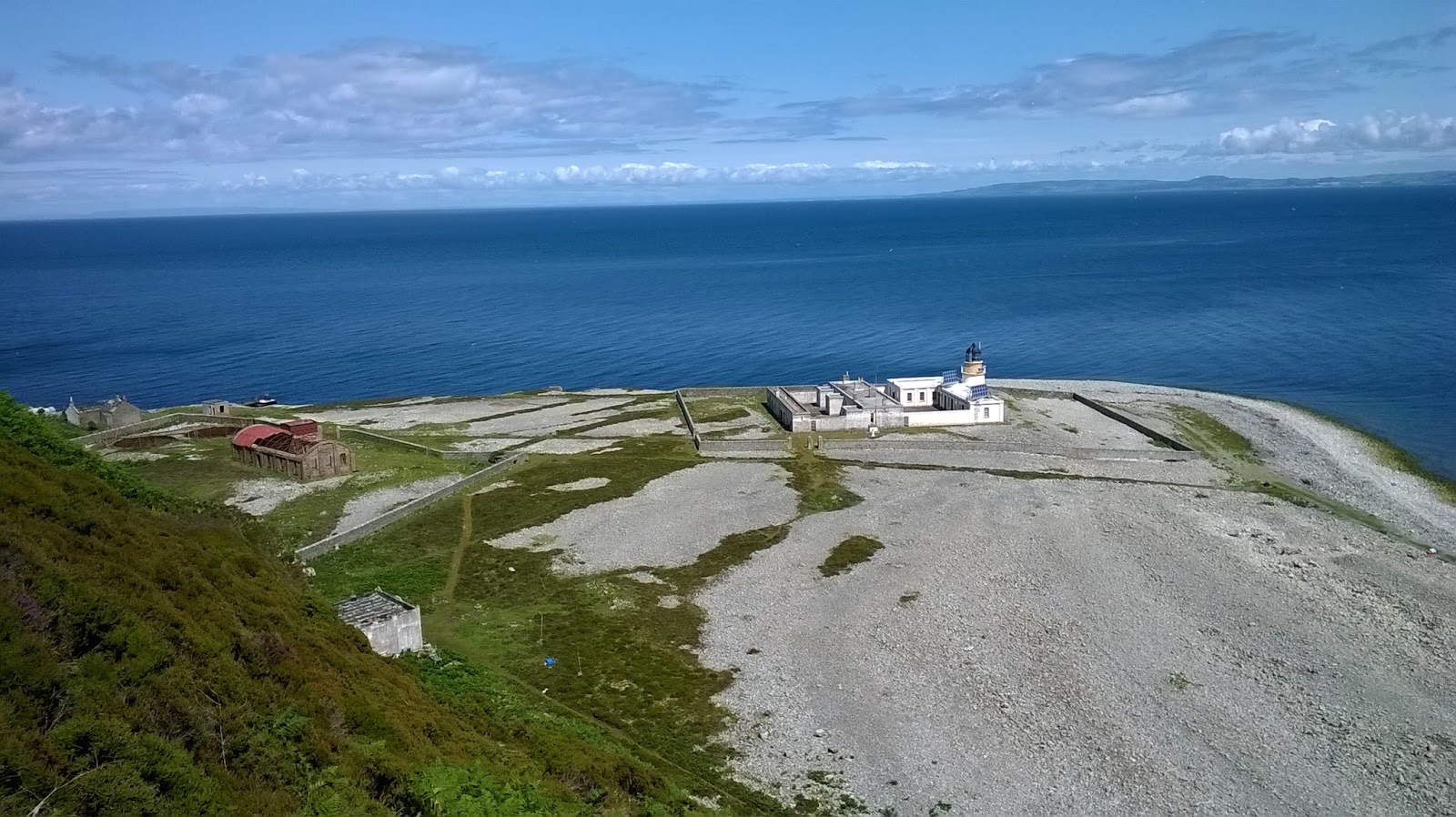
We only had time to climb up to the Castle - but even from here the views are superb as you can see the small area of flat land where the quarrying operation was centred. The lighthouse is now automatic so nobody lives on the island anymore.


 We then drifted round the island and set off for Cushendall.

Homeward bound
 The homeward journey was choppier and took longer than the outward journey and we arrived at Cushendall around 1800. We only saw 20 species but what we lacked in numbers we made up for in quality and quantity of birds - gannet, fulmar, manx shearwater, guillemot, razorbill, puffin, black guillemot and kittiwake were all seen in large numbers. We also picked up ripit, mipit and Raven - the only passerines on the island apart from wren. All in all a mega birding day which will live long in the memory. The icing on the cake was a red-throated diver just off Cushendall on the way back. What it was doing there in July we had no idea, but it was an extra tick on a bird filled day. 

66  Buzzard

Pennington Flash, Lancashire.

I have been visiting family in Bolton and was able to get three hours on Friday morning at Pennington Flash, a Country Park near Leigh. It is formed from subsistence and is a large area of open water with woodland, golf course, nature reserve, boating etc. There are a number of hides and it has a good selection of species and a reputation for turning up unusual visitors. There is also a well stocked feeding station which attracts a good variety of species which are not found in Northern Ireland or are hard to see here. The target bird was willow tit which I missed in February and it was duly ticked. I also got a good view of stock doves, jay, reed warbler, ringed plover and a green sandpiper. Total for the visit was 39 species and a fox which scattered everything on a spit of land I was watching from one of the hides. It made a dash out to try and seize a meal but failed to nab anything. Just before Mr Fox appeared I had good views of a kingfisher which perched and fished in front of the hide. Later on I watched 7 herons roosting at another hide, and there were also a couple of common terns sitting on buoys. All in all a very pleasant three hours.

The view from the hide

Feeding station

Mr Fox heading off hungry

Sunday, 5 July 2015

Rathlin

I should be doing a double post here, one for the walk from the West light and one for the boat trip round the island. Unfortunately the weather put paid to the boat trip and it has been re-scheduled the day we travel to England for a long weekend. So just one trip to tell you about.

It was the hottest day of the year and  I came away with 37 species including brilliant views of singing skylark, two great skuas off the West light and the usual brilliant views of auks fulmars and kittiwakes. The new seabird centre is not fully open yet but you can access the viewing platform as in previous years. Entry is still free to all . We took the bus out and walked back along the road. The harbour was full of eiders with young but as we took the fast ferry there and back we did not see much on the way across. There were also good views of linnet, stonechat and whitethroat.  My best day out on the island had 48 species so I missed out on a few but all in all I have no complaints about a stunning day out. Dinner at the Thatched Inn Broughshane on the way home was the icing on the cake. 

Heaven on earth

Guillemot city

West cliffs at Bull Point.....

..... and looking South to the coast


Having turned for home when the bad news came through we ended up in Belfast at the tall ships and were surprised to see good close views of common tern fishing in the Albert Dock, black guillemot on the Lagan and lesser black backs all over the place. We even had a wood pigeon fly across at the railway bridge near the station. Nearest wood has to be Ormeau Park. There is a tern raft between Queen's Bridge and the weir and it appeared to have two common terns sitting on eggs. Hope they can fight off the lesser black backs.