Showing posts with label great white egret. Show all posts

Saturday, 16 March 2024

Citizen science and garden birdwatching

Returning home I was back at WOW with high water levels and 6 ringed black-tailed godwits to look at. The reserve is still in a late winter stage with all seven ducks, flocks of roosting waders and singing robins. To date the only sign of spring is an increase in the number of black-headed gulls coming to the two nesting platforms. Mediterranean gulls have been noted, but not by me. The list remains at 59 as I have mopped up all the winter species I can reasonably expect. 

The ringed godwits are all part of the ringing programme at the reserve in April 2021. Some have been noted away from the reserve in Whitehouse and Kinnegar as well as a few records from Wales. All part of the great citizen science project which is vey satisfying to take part in. Thanks to Gareth Platt who keeps an eye on our sightings.


The garden has also hit a late winter stage with fewer birds at the feeders and the last week of the Irish Garden bird survey which runs for the three winter months. Basically much like last year with all the expected species. Excitement this year was provided by a single jay, single treecreeper, 5 blackcaps, 4 siskins, 6 linnets and two redpolls. I managed 30 species over the 13 weeks of the survey and blackbird was again the most numerous on the list. I was able to add sparrowhawk to the list and could have removed a woodpigeon as when I returned from England this was the sight which greeted me in the garden. 

The high tide roost on Seacliff Road finally produced patch ticks of purple sandpiper and dunlin. Today a swallow and a common tern were reported at WOW which is a tad early for both species. Seems that climate change has kicked in following the warmest February on record. 


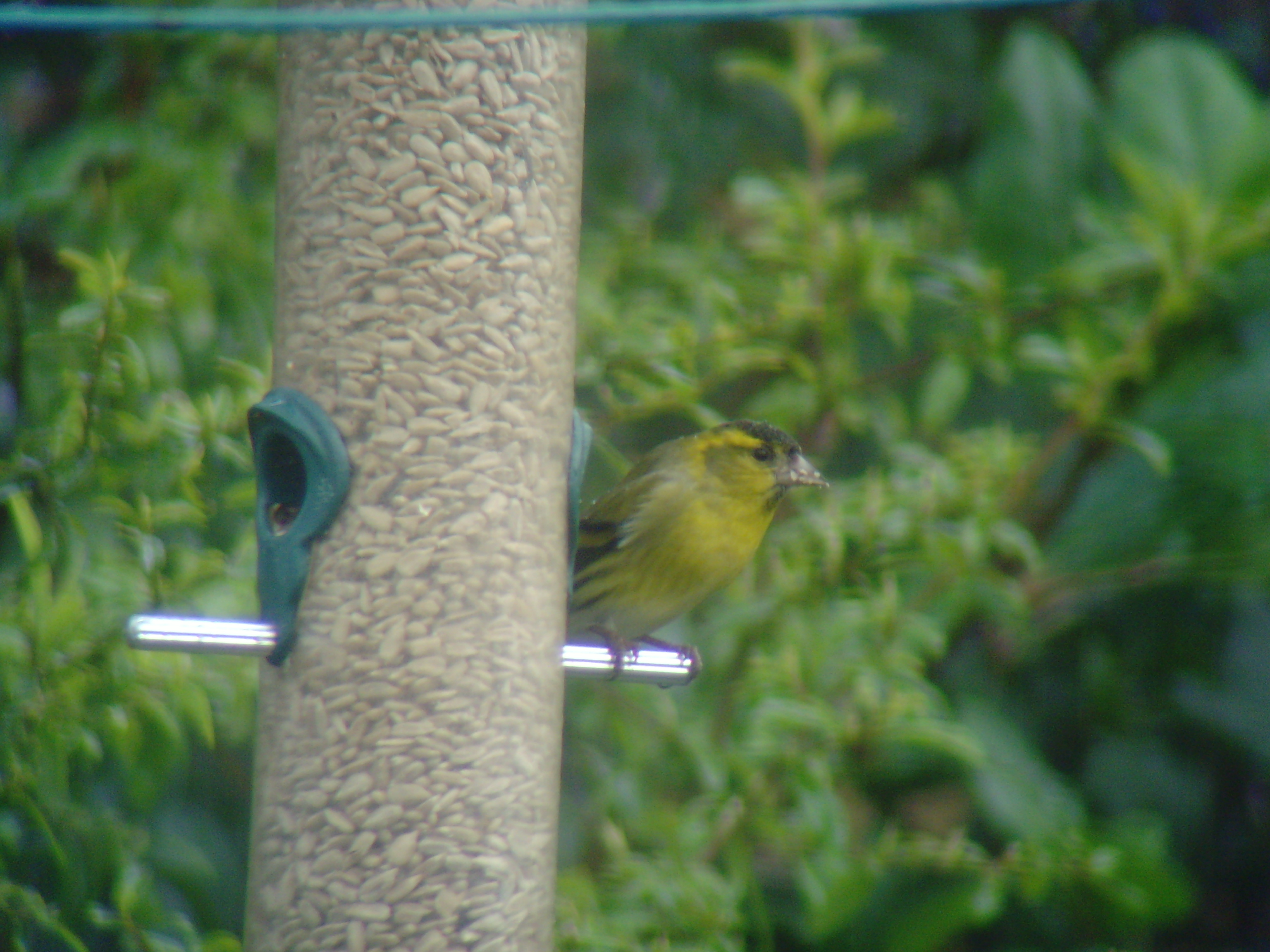
Female siskin

Long-tailed tit

Male siskin

Female siskin at the niger feeder

While I was in England there were a couple of tasty birds in and around Portmore Lough so we took a run up to have a look. They were both seen well. The great white egret is now a regular visitor to Northern Ireland - Portmore has had 5 this winter. Cattle egret is also a more regular visitor and this one had attached itself to the only cow on Brankins Island Road which made it easy enough to find but not as easy to photograph as it kept hiding behind it in the reedy sedge.  
Cattle egret hidden behind the hedge close to the road.

Great white egret is easier to see

House sparrows

Cattle egret further away but still hard to see

Tree sparrow
Next week we are off again to Bolton to cover the taxi runs as the grand-children are in school. Hopefully we will be able to take in the odd bird reserve!!

2024
117: Nuthatch
118: Cattle egret
116: Great white egret

WOW
59 Eider duck

NDCP
43: Goldcrest
44: Dunlin
45: Purple sandpiper

Friday, 20 November 2020

Great white egret

 Finally finally I ticked one of these in Ireland but in Antrim at Ballycarry Bridge not in Down. Having dipped a couple of times in Castle Espie one popped up at Ballycarry Bridge and as they say in birding circles was "showing well". This is usually a prelude to "Disappearing when Derek turns up", but not this time. No need to labour the point enjoy a selection of pictures and if you want really good ones check out the NIbird blog. 


 Locally on the patches it has been quiet, cold and wet and walks have suffered accordingly. There have been divers seen off the coastal path but not by me, however I finally saw a flock of lapwing in their old spot so some sanity has been restored to lockdown life. The garden has been overrun with coal tits and they are emptying feeders at a tremendous rate. Kibbled peanuts and sunflower seeds are being buried everywhere as they make multiple trips back and forth. I have seen at least 8 at one time but am sure there are a lot more than that. They have been joined by the regular cast of winter visitors albeit in smaller numbers so far. I think it will need colder weather to pull in more birds. 

A visit to WOW threw up 35 species with all the usual suspects. After one week of opening the observation room closed for 4 weeks and it looks like this will be extended to seven weeks as Northern Ireland locks down on the run up to Christmas. Back of the envelope calculations predict that it might open on Monday 14th so we might get along before the end of the year. In the present way of going nothing is certain so I'll not be taking any bets.  If it does re-open I will try and get a post up to give you some festive cheer. Remember that the light at the end of the tunnel may be a train coming the other way!! Here's a few cheerful pictures from Thursday.

Redpoll on the new feeder

Hard to beat a nice teal

Schnoozing schelduck!!

The swan couple have returned and could well fail to raise chicks again this year
 

2020   
155: Great white egret

NDCP
72: Lapwing

WOW
92: Stonechat


Sunday, 3 March 2019

Update from England - Part 2 South Yorkshire

We travelled south down the A1(M) to Bawtry to catch up with our friends who are now home from Cambodia. A trip there a few years ago seriously boosted the life list! We had a day at RSPB Old Moor reserve followed by a day at a newish Nottingham Wildlife Trust Reserve in the Idle Valley. First lets look at a shot from Hauxley which didn't make the cut, it shows waders at Hauxley and there are a couple of grey plover in it. One on the left with a group of dunlin and one sitting on a rock out in the water. The lapwing are all on the grass.

Hauxley waders
We have been to Old Moor before and had a good wander about. There were reports of booming bitterns, but not while we were there. The highlights from a list of 40 were sparrowhawk, green sandpiper, lesser black-backed gull, stock dove, tree sparrow and reed bunting.

The Idle Valley proved a bit of a challenge as it is a vast site which is still being developed. There is still sand and gravel extraction as well as farming activities mixed in with reserve areas and innumerable walks. We visited the new centre which overlooks a large lake and walked some of the paths along the River Idle. Then we went looking for a great white egret which was in one of the northern meres. We eventually got a half decent view through trees and later on got a better view but no photographs. The site list was a modest 38 but as well as the egret we also saw a red-crested pochard which has now colonised the area. Previously I have seen these in London parks but they have now spread north and are breeding in Notts. We also had a couple of ringed plover, not especially remarkable I hear you say, but the locals were coming to see them as they are rare in Notts which is about as far from the sea as you can get and they are normally coastal birds. I managed to resist the urge to say I had these within ten minutes walk from the house along the coastal path!

Chainbridge Scrape
The photograph shows the sort of habitat in the newer area where the sand and gravel extraction areas have been restored. The egret and plover were in this area, the pochard was in an older area where there was more vegetation, fishng facilities and parking areas. I reckon you could spend two days there between the newer northern areas where there are several meres such as the one in the photograph and the older southern area where there is more woodland and riverside walks. A very pleasant day out with several village pubs serving good food and beer close to hand.  Here is a link to their web site just in case you are ever in the area and looking to bird. There is a map on the site and you can get good maps with walks from the Information Centre. You really would need a map and a bit of time to do the site justice.

https://www.nottinghamshirewildlife.org/nature-reserves/idle-valley

So we moved on to Lancashire with the 2019 list climbing well over the hundred.